

|
War of the Woods |


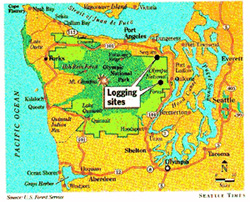 OLYMPIC NATIONAL FOREST- Any
day now, when the snow stops piling up in the foothills, loggers will cut
down a stand of moss-draped, 3-century-old trees, the first clearcut of classic
old-growth forest here since the northern spotted owl essentially ended the
practice on federal land five years ago.
OLYMPIC NATIONAL FOREST- Any
day now, when the snow stops piling up in the foothills, loggers will cut
down a stand of moss-draped, 3-century-old trees, the first clearcut of classic
old-growth forest here since the northern spotted owl essentially ended the
practice on federal land five years ago.
The logging, which would be illegal had Congress last year not suspended the Endangered Species Act to allow it to happen, has re-ignited the war of the woods that dominated the Pacific Northwest at the end of the last decade.
The man who will chain-saw the trees says a caller threatened to burn down his house. The United States Forest Service has barricaded the woods because someone tried to sabotage the road to the 55-acre stand, considered prime habitat for both the owl and a threatened seabird, the marbled murrelet.
Across the Northwest, environmentalists are attending civil disobedience training sessions. Federal judges again find themselves in charge of forest policy. And loggers, though happy to be working, say the days are back when they are vilified for giving society the wood it demands.
"It's a little like we've gone back in time," said Ben Kizer, ranger for the Olympic National Forest's Quilcene District.
The conflict will only worsen by spring, predict people on all sides of the debate. As much as 10 square miles of old-growth forest, some of it in wild areas with no roads and much of it previously protected for the spotted owl, may be logged this year in five of the state's national forests.
Last month, some clear-cut logging began on federal land--also in the Olympic National Forest. Nearly 100 acres of 120-year-old trees, considered very young for "old-growth" but still potentially spotted-owl habitat, are being cut near Sequim, Clallam County.
An act of Congress
All of this came about not because anything changed with the owl or the condition of old-growth forests. The decision to cut was not an act of science but an act of Congress, says Ron DeHart, a spokesman for the Forest Service.
"It's a bit hard to explain or rationalize what's happening," he said. "It's all political."
Last summer, Congress passed a measure called the "Emergency Salvage Timber Sale Program." It encouraged speedy logging of dead and dying timber that had been marred by fire, insects or windstorms.
The new law also resurrected a series of logging operations of healthy trees in old-growth forests. These timber cuts were canceled years ago when the government decided the logging would harm either the spotted owl or the murrelet. To make the logging legal again, Congress on a spot-by-spot basis suspended the Endangered Species Act and most other environmental laws. The move was supported by every Washington member of Congress except Patty Murray and Jim Mcdermott.
Supporters argued that devastated timber communities needed the wood. Slade Gorton, who sponsored the measure, says the government had promised to sell these trees in 1990 and now was obligated to do it (although, in many cases, contracts were never signed.)
They also say the government has failed to deliver the promised amount of timber in the past few years under its own plans. Nationally, the Forest Service sold only two-thirds of the wood it was projected to sell in 1995, according to Forest Service figures.
Less logging than peak years
Those who make a living in the woods say all perspective has been lost since the spotted owl brought most logging on federal lands to a halt in 1990. The return to old-growth logging this year will clear only a minuscule portion of the region's remaining ancient trees, they say.
In the Olympic National Forest, for instance, all the clearcuts ordered by Congress would yield 3,400 semitrailer loads of wood. Compare that to the late 1980s, when 50,000 loads were taken from the Olympic National Forest every year. The highest yield ever was 80,000 loads per year in the 1970s.
Depending on how you measure it, this national forest has anywhere from 50,000 to 100,000 acres of "oldgrowth" forest remaining. These controversial sales, which include seven more tree stands near Forks and Lake Quinault that may be cut later this spring, would clear-cut a total of 350 acres.
"This is vital to us and to our family," said Barb Soderlind, whose husband, Dave, is doing the logging near Sequim. "We don't believe in clear-cutting the whole peninsula either, but these are small, small timber sales. We look at trees as a crop. We're farmers of that crop. And we're hated for that."
But cutting even one more tree is unacceptable for those who believe too much virgin forest already is gone. The Olympic Peninsula, including the vast Olympic National Park, is thought to have once had two million acres of old-growth. An estimated 85 percent has been cut since World War II. Most of what remains is inside the park, a dedicated wilderness where logging is prohibited.
Old style of logging
Still, environmentalists are most upset because they believe Congress chose to cut this old-growth the old-fashioned way, with little regard for salmon or the owl, casting aside advances in forestry that experts believe can ease logging's effect on the landscape.
Today, few clear-cuts are done on federal land, and large strips of trees must now be left around streams to protect fish. But Congress said this logging could proceed as it would have when first offered for sale in 1989. In many cases, that means clear-cuts, streams stripped of tree cover, and few amenities such as snags or ground cover left for wildlife, Kizer said.
Near Sequim, Soderlind could have logged all the trees away from one creek and used another creek as a skid road for his logs, Kizer said. Instead, he agreed to leave trees near the streams in exchange for cutting trees elsewhere. Soderlind also voluntarily left standing six isolated 400- to 500-year-old Douglas firs, though each one is worth $2,000 to $3,000 at the mill.
But there's no denying it's a clearcut. The stream buffers are less than half what's required now. On federal land, "We simply don't do logging like this anymore," Kizer said.
Congress also ordered the logging to proceed immediately, without any further environmental review.
The logging expected to begin soon near Quilcene, Jefferson County, will fell a stand of 275-year-old trees where nobody has ever checked for marbled murrelets. No one has looked for a spotted owl there since 1989, when owls were detected a half-mile away, according to Marilyn Stoll, a biologist with the U.S. Fish and Wildlife Service.
"We didn't survey it because we thought it would never be logged," Kizer said.
The stand of trees is situated on hills above the Dosewallips River. Most of the trees are on a steep grade that reaches 70 percent in places. (A 90 percent grade is a sheer cliff.)
Barring further congressional action, this type of old-growth cutting will continue through 1996. When it's over, the Olympic National Forest will be closed to such logging again, according to the government. Loggers will be allowed to cut 2,000 truckloads of wood each year from federal land, but almost none will be trees more than 80 years old.
Even if old-growth logging ends; what may linger are feelings of bitterness and mistrust that have been unearthed again on all sides of the Northwest forest debate. Many people felt the old animosities were slowly giving way to a new spirit of cooperation as the region learned how to cut timber while protecting the environment.
Now the conflict is as intense as ever, some say.
"This has polarized everybody again," said Bonnie Phillips of the Pilchuck Audubon Society. "It's an extraordinary setback. We're all fighting and spending all our time in court, just like we used to do.
"That doesn't bode well for the future."
Originally appeared in The Seattle Times, Wednesday, January 31, 1996. Reprinted in its entirety by permission.

 Washington's new forest plan

| Disclaimer . © Copyright 1995, 1996, Better World Publishing All rights reserved. Better WorldSM and BWZ are Service Marks of Better World Publishing .... Questions and comments? |

|
|
