

| Envisioning a Sustainable Future |
by Chris Nelder |

As we look deeply into the question of how to make a better world, every direction leads to one essential fact: most of our current activities are not sustainable. In spite of the laudable efforts for conservation, recycling, and forms of socially responsible business, the end result falls far short of sustainability. In our current market dynamics and resource utilization, we are, by definition, seeing to our own demise.Our global transition to sustainability will have to be fundamental and profound, and undoubtedly a little painful. For most citizens of the world--and particularly for those in first world countries--it will mean tangible changes for every single one of us. The sooner we act, however, the less painful it will be.
IF we act now.
|
Contents What is Sustainability?
The Carrying Capacity of Earth A Peaceful Place, Or So It Looks From Space |
What Is "Sustainability"?
The term "sustainability" is certainly arguable in the details, but we can say what it means intuitively: it's where what goes out is no more than what goes in. Author and entrepreneur Paul Hawken describes sustainability like this in his seminal 1993 book, The Ecology of Commerce [a principal resource for this article, which we encourage you to buy and read]:
Sustainability is an economic state where the demands placed upon the environment by people and commerce can be met without reducing the capacity of the environment to provide for future generations. It can also be expressed in the simple terms of an economic golden rule for the restorative economy: Leave the world better than you found it, take no more than you need, try not to harm life or the environment, make amends if you do.
Sound simple, doesn't it?
The March To Self Destruction
Unfortunately, the current path of commerce that we tread resembles more a march to self-destruction than it does a "restorative economy." While the problems that confront us are myriad, there are a few standouts: population, resource scarcity, and environmental degradation.
The Carrying Capacity Of Earth
Here's the simple fact of the matter: the resource supplies of Earth are dwindling, and our numbers are continuing to explode. We are already exceeding the "carrying capacity" of the planet, and further growth will do naught but continue to destroy our host--the Earth. Hawken defines carrying capacity as "the maximum level of a species or a population that can be steadily and consistently supported by the resources" of the planet. We have grown increasingly distant from self-reliance, and are moving steadily toward a downright predatory demand for foreign resources.
In first world countries, we are increasingly reliant on imports of resources and energy from other parts of the world to satisfy our needs. In some third world countries, this dynamic takes the form of spending all day to collect enough brushwood just to cook the evening meal. (Although the growing use of solar box cookers has helped in this particular matter, the greater fact remains that arable land and drinkable water is diminishing rapidly in those areas.)
The main reason why we are exceeding our carrying capacity is population. Our numbers are growing exponentially. Around the beginning of the twentieth century, we grew by 6 million per year. By 1950, 18 million per year. By 1975, 60 million per year. We now add 100 million per year to our numbers.
A recent study by a British research group found that the globe can sustain around 2 billion people at Western standards of living. Our population today stands at 5.8 billion, call it 6 billion by the end of the century. By 2050--a time when many of us are still planning to be around--we can expect to number around 12 billion people.
Our global resources of water and food are already stretched to the breaking point in some areas of the world, and are weakening in others. What will our world be like with twice as many of us, a mere 54 years from now?
Our numbers aren't growing in the same places that resource usage is growing, however. Developed nations consume far more than the rest of the world. The lopsided resource demand--and accumulation of wealth--in the first world has only increased in recent decades.
Between 1960 and 1980, the gap between rich and poor nations has increased from a factor of 20 to a factor of 46, and it's still widening. According to the World Bank, "Even if the growth rate of the poor countries doubled, only seven would close the gap with the rich nations in 100 years. Only another nine would reach our level in 1000 years."
Let's hope it doesn't happen. It's accepted as gospel among researchers that if the residents of China enjoyed the same standard of living as those in the United States, our global limits would drive us to collapse.
A Peaceful Place, Or So It Looks From Space
For decades, scientists such as Paul Erlich have predicted conflict over resource shortages, but only in recent years have studies tested the prediction. A group of 30 researchers organized through the University of Toronto and the American Academy of Arts and Sciences warned: "Scarcities of renewable resources are already contributing to violent conflicts in many parts of the developing world. These conflict may foreshadow a surge of similar violence in coming decades, particularly in poor countries where shortages of water, forests and, especially, fertile land, coupled with rapidly expanding populations, already cause great hardship....We maintain...that the renewable-resource scarcities of the next 50 years will probably occur with a speed, complexity and magnitude unprecedented in history. Entire countries can now be deforested in a few decades, most of a region's topsoil can disappear in a generation, and acute ozone depletion may take place in as few as 20 years."
The few years since they published their warning--which was around the time that America was in the thick of protecting its oil interests in Kuwait through violent conflict--have provided ample evidence of its truth. Increasing violence between countries and populations worldwide have increased, and directly or indirectly, those conflicts are about natural resources: land, water, food, trees, minerals.
Water Wars?
The Worldwatch Institute and other perceptive watchers are quick to point out that the most explosive potential lies in the increasing need for fresh water. Water tables have been dropping steadily worldwide, with no plan for restoration, while demand continues to climb. Water scarcity means food scarcity. Some have dismally predicted certain war in the Middle East over water within a decade.
Some have placed optimistic hopes in new technologies to overcome the pain of water scarcity. For example, a Northwest entrepreneur ran trials in the Puget Sound this April on a plan to tow huge bags of fresh water-- 4.5 million gallons apiece--from remote fresh water sources such as Alaska to the needy areas like the Middle East. Although the trial proved the concept, the bags leaked and the problems of towing them in heavy seas became evident.
In a small way, this technological attempt at addressing the problem demonstrates the larger theme: the solutions to basic resource scarcity, especially when that resource is water, can never be found in increasingly complex, superhuman efforts; it can only reside in the simple--living within one's means.
A Straight Line Never Reaches Infinity
Our unsustainable usage of resources, and our continuing accumulation of waste, points up the basic flaw in our current system: it operates in a straight line. From the extraction of raw materials, through wasteful production processes that produce toxic by-products, to products with very limited utility, and ultimately, to waste which accumulates in landfills, our current system of manufacturing and using products is a one-way street.
For example, think about the plastic bags we get our groceries in. Produced from virgin fossil fuel sources, plastic bag manufacturing results in environmentally harmful by-products. The bag is probably used once, for about fifteen minutes, to transport your groceries from the store to home. Once home, it may see another single use as a garbage bag, and from there, it's off to the landfill--where it will remain very much in its current form for at least a hundred years. Why do we manufacture single-use items to last that long?
Unless you're talking about a system in which there is unlimited resource availability and unlimited waste disposal capacity, producing, consuming, and discarding goods in this straight-line way is obviously not sustainable. Our system is closed--what goes "out" eventually must come back "in."
Living on the Banks of Denial
Disagreement about the effect of human activities on the environment is great, and one can find an "expert" to argue any side of a given point. While we haven't seen the bills for our activities, it's easy to deny that there's even a balance due.
Being slow to recognize that we're waist-deep in the Big Muddy isn't the worst of it, however. There are highly literate people in power who are willfully plunging their heads into the sand and refusing to see. In July of '96 the New York Times published an editorial by staff writer John Tierney, decrying household recycling efforts as "the most wasteful activity in modern America," and arguing that for cost reasons, the only sensible thing we can do is continue to fill up more landfills.
Aside from the painfully misinformed hubris of his argument, and the possibility that others might actually agree with it (although not likely those who have to live near the massive landfills that he proposes to bury his trash in, far away from New York City), it points out the crux of the problem: it is cheaper to keep burning up virgin resources and burying the waste. The economics of the market is where we need to begin.
But there is no question that we need to begin, and now. We cannot go backward to idyllic notions of infinite resource supplies, nor can we continue with business as usual. The need for sustainability is absolutely undeniable, and at this late point in the game, efforts to oppose it are as short-sighted as they self-destructive.
Finite Capacity
The size of the earth, and its ability to renew resources, is absolutely finite. If it grew, we could sustain our growth rates. But it does not. The only continuous input to the planet is solar energy, but we do not live on that. We live on the accumulated wealth of tens of millions of years of solar energy, as stored in fossil fuels. In economic terms, we are living off our savings.
And yet, the capitalist reliance on perpetual growth is not only unshaken, it is gaining ground. Large corporations are seeing their salvation in new global markets, which are eager to participate in the grand success story of Western materialism. In the recent debate between the Vice Presidential candidates in America, Republican Jack Kemp returned over and over again to his assertion that if we could only return to the economic growth rates of the past, our problems would be solved. Experts are trundled out by the thousands to testify that our exploitation of the planet's resources has only begun to enjoy its best days.
Hawken has fierce words about this renewed passion for growth: "This counter myth of 'no limits' is so powerful that it appears ironically to be gaining ground, in a reflexive, psychological reaction of denial, even as knowledge of the carrying capacity of the earth becomes more evident. Ever-expanding abundance is not a theory based on science, or history, or nature. It is based solely on self-interest. Whether willfully ignorant or unabashedly hypocritical, at some point we must ask business to look candidly at the real world and see the skull-and-crossbones posted alongside ecological pathways, so that we can begin to create real solutions instead of illusory techniques of evasion." "In biological terms," he continues, "we have become a parasite and are devouring our host."
The Ecological Mortgage
And yet, some continue to believe that technology and human invention will find new creative ways for us to extend our consumption beyond today's "income" without running up against scarcity. The flaw of that reasoning is revealed in rephrasing it: if we can keep finding new ways to borrow from the future, we'll never have to pay the bill. Sounds a lot like the Federal approach to budgeting, doesn't it?
Author Dennis Meadows explains it this way: "Economists assume the future will be much like the past. Since markets and technology have avoided catastrophe in the past, we can count on them to do the same in the future. Ecologists believe they see unique problems in the future, which will demand solutions outside the capacity of our present market mechanisms. Economists tend to see evolution as a series of continuous reversals: problems leading to solutions, new problems leading to new solutions. Ecologists are worried about irreversibilities. When species are lost, no change in price or technology will bring them back."
The only reason we can continue this endless borrowing trick today is that the products we consume today do not reflect their actual ecological costs. Though we continue to produce massive amounts of food, a closer look reveals that the profit has been short-lived. Overreliance on pesticides and herbicides, wasteful or improper irrigation, unsustainable growing practices and overproduction have greatly diminished topsoil and the productive capacity of the land. According to the EPA, "pesticides, herbicides, and fungicides applied to our soils and foods pose the greatest environmental threat to American citizens other than the global threats such as ozone depletion, global warming, and overpopulation."
Hawken explains: "Gasoline is cheap in the United States because its price does not reflect the cost of smog, acid rain, and their subsequent effects on health and the environment. Likewise, American food is the cheapest in the world, but the prices does not reflect the fact that we have depleted the soil, reducing average topsoil from a depth of 21 to 6 inches over the past hundred years, contaminated our groundwater (farmers do not drink from wells in Iowa), and poisoned wildlife through the use of pesticides. When prices drop, effectively raising real income, people don't need to think about waste, frugality, product life cycles, or product substitution."
Global Warming
In spite of the obvious truth that we cannot sustainably continue to burn fossil fuels at the rate we have been, the demand only slackened briefly during the 1974 energy crisis. Aside from the fact that it is a key resource to our way of life, and that it is unrenewable, is the immediate problem of the carbon dioxide that its combustion produces, and the subsequent effect of carbon dioxide on our environment.
Hawken suggests this exercise: to imagine how much carbon dioxide we're talking about, think about just the carbon component. "Every time you fill up and use a tank of gas in a medium-size American car, you are depositing in the atmosphere the equivalent of a 100-pound sack of pure carbon, 5.6 pounds for every gallon of gasoline." Now imagine all of power plants, industry, air travel, and everything else that burns fossil fuel. "When the year is over, not counting the 1 to 2 billion tons of carbon placed into the air from burning forests and grasslands, every person in the world will have placed 2,363 pounds of carbon into the atmosphere [assuming we all contributed equally, which we know is not the case], a total of 5.9 billion tons, three and a half times as much as we emitted 30 years ago."
For those who are still inclined to argue that Mother Nature is prepared to deal with all of this output, consider that we're pumping three to four times as much carbon into the atmosphere, annually, as any year of natural events would cause. And we're making this atmospheric change at an unprecedented rate. The cycles we can detect from Earth's past may or may not apply to our current situation.
We don't know for certain that global warming is happening. What we can be certain of is that if we keep going as we have, it will. In a mere 500 years, we will have increased the carbon dioxide in the atmosphere by a factor of 10.
The potential effects of global warming are extreme, with only a few degrees change needed to produce massive floods, the withdrawal of forests, and the death of species or entire ecosystems. Dr. Thomas Lovejoy, of the Smithsonian Institute, comments: "I fail to see that there's any conclusion to draw from all of this other than that there will be massive extinction no matter what we do in the way of conservation. Therefore, the only logical conclusion is to prevent as much of the climate change as possible."
The Tragedy of the Commons
The "tragedy of the commons" is that the less direct ownership a resource has, the more it will be exploited and the less it will be properly cared for. When extracting wealth without regard for environmental costs is rewarded, the burden of restoration is left to the state, which usually becomes more an exercise of damage mitigation in a degraded environment than true restoration.
We have made our way, step by step, to a place where nearly everything we have and everything we do is reduced to money. Money controls the activities of humanity. We convert our forests into money, not for moral, social, or environmental reasons, but for market reasons. If a company clear cuts a forest at the bargain basement blowout prices offered by the Forest Service, and moves on, they get an incredible return on their investment. If they have to manage a sustainable forest over a long period of time, the return is more like an unimpressive 9 percent.
Money frames the debate over public policy, in the multi-billion dollar industry where Congressional favor is curried, and where expensive television propaganda is created. Money is the means by which industry obtained the power to rewrite clean water and clean air legislation to their own liking.
But the money isn't in our hands, like our democratic power presumably is. It's in the hands of the elite. Hawken gives the numbers: "One percent of American society owns nearly 60 percent of corporate equities and about 40 percent of the total wealth of this nation. These are the plutocrats who wield the power and control this preeminent 'company town' while trying to convince the other 99 percent of the citizenry that the system works in our best interests, too."
The result of this power imbalance is on the face of the land, and in the air: Clear cuts. Strip mines. Toxic waste sites. Nuclear power plants that nobody wants to pay to decommission, and nuclear waste that no one has any idea how to safely store for the requisite period of time. Things that nobody in their right mind would do if it was their land.
Well here's the news flash--it is your land. The people haven't gotten anybody's idea of a fair price for their resources, ever. It's been a grab from the get-go. And it's your water that those toxins are leaching into; the air that you breathe. The cancer my friend, is blowin' in the wind...
The Final Loss
Of all our environmental debts, there is one that we cannot pay: extinction. It is estimated that of the possibly 4-5 million species on the planet, we have only cataloged a fraction--20 percent or less. Whatever secrets to survival these species hold, we are losing our last chance to discover them at an astonishing rate--a rate, in fact, that we cannot even measure.
Hawken explains: "At the present rate of extinction--estimates range from 20,000 to over 100,000 species every year--we may lose 20 percent of all the species on the planet within the next twenty to forty years, most of these in the tropical rainforests. In the United States, if present global warming projections are correct, we will face losses of 20 percent of our 20,000 plant species. It's also worth nothing that many species, even though not yet at risk of completely disappearing, are being so severely depleted genetically that their ability to reproduce and adapt is increasingly impaired. The loss of evolutionary potential is being called the 'death of birth.' This is tantamount to marching backward through the Cenozoic Age, losing millions of years of evolutionary development in a matter of decades. We will face what naturalist Jack Turner calls the 'final loss'--that point in the not-too-distant future when environmental degradation on the planet will no longer require our active participation."
The Warning of the Frogs
"But these are all rather distant problems--aren't they?" naysayers will argue. "Sure, we lose a few species here, a few there, but if it's not bothering me, well, what's the problem?"
The problem is that we have polluted our environments with toxins that bioaccumulate,that become concentrated as they move up the food chain. Hawken explains the risk: "The reason we may not yet be experiencing the same types of breakdown seen in other species is because we gestate and breed comparatively rather slowly. On complex biological levels such as ours, bad news travels unhurriedly, but it eventually arrives. In other words, something unusual and inauspicious may be occurring globally at all levels of biological development: a fundamental decline that we are only beginning to comprehend and that our efforts at 'environmentalism' have failed to address."
Well, here's some recently arrived bad news, from that happy amphibious bunch, the frogs. The New York Times reported in a 1992 article "The Silence of the Frogs" that frogs are disappearing from the face of the earth at an inexplicably rapid rate, not just in industrial areas, but in pristine wilderness areas such as Yosemite.
A recent article in the Washington Post provides more details, about large numbers of frogs showing up in the Great Lakes region with extreme deformities and mutations. The investigation into this phenomenon is extending into the realm of frog genetics.
As the frog scientist quoted in the article explains, we have reason to be concerned about more than just frogs. Because our endocrine systems are similar to theirs, "frogs serve as a 'sentinel species' because many of their metabolic functions--notably in the liver, where a variety of agents are processed out of the body--are similar to the same processes in humans. 'Now the whole state appears to be affected,' he said. 'We should be alarmed.'"
Bailing out the Titanic with Teaspoons
It's clear that given this state of affairs, mere conservation and recycling isn't going to cut it. Our entire economic system needs to be turned on its head, and a new ethic of sustainability needs to be swallowed and digested in a big hurry.
Hawken makes an apt comparison: "From this perspective, recycling aluminum cans in the company cafeteria and ceremonial tree plantings are about as effective as bailing out the Titanic with teaspoons. While recycling and tree planing are good and necessary ideas, they are woefully inadequate. How can business itself survive a continued pattern of worldwide degradation in living systems? What is the logic of extracting diminishing resources in order to create capital to finance more consumption and demand on those same diminishing resources? How do we imagine our future when our commercial systems conflict with everything nature teaches us?"
The Path to Sustainability
If you skipped past the first part of this article because you just can't stand to hear the litany again, we do empathize. It's not a pretty picture and it can leave one feeling helpless in the face of problems too large to affect.
But we firmly believe that it's too early to just throw in the towel and call it game over. We'd like to have children with a clear conscience that we're leaving them a world worth inhabiting, and a future that holds promise. We have about a thousand years' work ahead of us, but it can be the most exciting work yet.
The challenge is to identify the path, and then have the will to follow it. There are some good ideas and demonstrated solutions available to us. Let's take a look at some of them.
To Dance in a Circle
As we have seen, a system that moves in a straight line of consumption requires an infinite supply, which we do not have. Intuitively, we can recognize that the whole natural world of which we are a part operates successfully in a cyclical manner; therefore, we must move in accordance with it--we must dance in a circle, not a straight line.
Hawken puts it elegantly: "Any ecological model of commerce must not only mimic nature in recognizing that waste equals food, running off of current solar income, and protecting diversity, but it must also have firmly and clearly in place feedback that allows it to recalibrate constantly and quickly adjust its costs, supply, and demand. Instead of following the cyclical paradigm, most of our resource businesses today are linear systems that by their nature receive and give out the "wrong" information to themselves and the greater environment."
Instead of endlessly demanding virgin resources, and then struggling to find a place to bury it when it becomes waste, we need to organize our activities so that there is very little waste to begin with.
Letting Business Lead the Way
Businesspeople are not evil, nor are they uncaring about the environment. Many of them care deeply about the effects of their business on the environment and on society. But like most people, they are confronted with the pressing issues of today, such as competing in markets that move ever faster, holding onto their jobs, providing for their families, and generally leading busy lives. The problems of the future loom like a tidal wave far out at sea; big, yes, but not here now.
While the efforts of individuals and small community groups can point the way, the move to sustainability can only be done with the willing participation of the market, because the market is where the money and power is. "Consider this fact," Hawken notes, "If the items used in households in America were all recycled, this would reduce our solid waste by only 1 to 2 percent."
Author Kirkpatrick Sale goes straight to the point: "Nothing less than a drastic overhaul of this civilization and an abandonment of its ingrained gods--progress, growth, exploitation, technology, materialism, humanism, and power--will do anything substantial to halt our path to environmental destruction, and it's hard to see how lifestyle solutions will have an effect on that."
The objection to "doing the right thing" that business most often gives is that "it will put us out of business." And they're right, if the economy remains structured as it is today. What business is doing today is not sustainable. And sustainability does have a cost.
Working With the Market
The influence of the market on human affairs is no doubt much greater than that of any political body or mere code of ethics. A recent article by the Chicago Tribune, citing a study by the Institute for Policy Studies in Washington, reports that the economic power of the world's largest corporations has become larger than that of the countries where they do business. In fact, more than half of the 100 biggest economies in the world are corporations, not nations. And the top 200 economies, controlling 28 percent of the total world economy, employ barely one-third of 1 percent of the world's workers.
Hawken: "Ironically, business contains our blessing. It must, because no other institution in the modern world is powerful enough to foster the necessary changes. Perhaps during the many battles between environmentalists and businesspeople we have been asking the wrong question all these years. As generally proposed, the question is 'How do we save the environment?' As ridiculous as it may first sound to both sides, the question may be 'How do we save business?'"
In order to work, any plan for sustainability must take into account our natural inclination to shop for the best price, and for business to make a profit. Simply asking people to pay more for sustainable products, while there are cheaper alternatives of comparable quality available, will never work on a massive scale.
Principles of Sustainable Business
Hawken offers this list of principles for sustainable enterprise. All too often, however, declaring a list of principles is often where the process stops in business. Converting principles to practice is the real challenge.
Sustainable businesses:
- Replace nationally and internationally produced items with products created locally and regionally.
- Take responsibility for the effects they have on the natural world.
- Do not require exotic sources of capital in order to develop and grow.
- Engage in production processes that are human, worthy, dignified, and intrinsically satisfying.
- Create objects of durability and long-term utility whose ultimate use or disposition will not be harmful to future generations.
- Change consumers to customers through education.
A New Economics
The real solution bypasses political arguments and transcends market objections: a new economics which enforces payment of the total costs. It addresses the problem at the root, where waste is created--at the manufacturer. The incentive to offer a competitively priced product will work in favor of sustainability, rather than against it, because the product with the lowest cost will also be the product produced most sustainably.
There is no need to overhaul the market; we just need to make it work in our favor. Or, as Hawken describes it, we need to let complete "information" pass through to the consumer and the buyer; we need to hear "the whole story." In this way, economic success becomes equivalent to biological success, instead of opposed to it.
Getting complete information works both ways: when consumers get full information about the cost of a product, they can make intelligent choices that ultimately lead in a sustainable direction. When markets get complete information about the positive and negative feedback of customers, they have the opportunity to respond intelligently.
Defenders of the status quo will argue that the integration of cost will threaten growth, raise prices, and require more legislation. And that's partially true--prices of goods do need to be higher, if products are to reflect their true costs. However, we must recognized that we're paying the costs already, in the currency of health costs, toxic cleanup programs, scarcity of resources due to environmental degradation, and ultimately, reduced output. When those burdens on our economy are replaced by healthy and sustainable productivity, we'll be further ahead on balance.
Integrating Costs
Several ways of integrating cost and price have been proposed. One early pioneer was Nicolas Pigou, who argued in his 1920 book, The Economics of Welfare, that environmental costs should be transferred to the originator of the cost via a tax. The incentive profitability by reducing costs would create an economic system that improved over time, rather than one that degraded over time as we have now.
Building on the idea, Hawken favors the notion of a "green tax," which would be an explicitly revenue-neutral way of approaching the problem. The plan is simple: tax nonrenewable and polluting activities. "Every incremental dollar collected from green fees should reduce income and payroll taxes equally, starting with the lowest income brackets and moving to the highest. It is critical that green taxes not place a burden on lower economic brackets or the middle class, because their purpose is not to punish but to reward." In this way, the burden is shifted away from good things, like income, enterprise, and productivity, and toward consumption and waste.
The San Francisco-based policy group Redefining Progress has proposed a different solution: recalculating the Gross Domestic Product, and all associated indexes, in such a way that costs are recognized. (See Learning for a Better World, in this issue.)
Eliminating Waste by Eliminating Waste Incentives
One good way to reduce waste is to make it unprofitable. This technique is perhaps the easiest of all, because rather than calling for a tax, we merely need to eliminate the artificial incentives to waste.
In Japan, legislation requires that manufacturers begin labeling parts for recycling, and establishing recovery centers for discards. In response, industry has been rapidly finding ways to build with recycled materials, build for disassembly, and use less wasteful products and processes.
In Germany, legislation requiring industry to recycle 80 percent of all packaging or face a 30-cent surtax on it, led to the formation of the Duales System Deutschland, which collects recycled goods from homes. The goods are identified by a green dot, which producers pay for and warrant that they will reuse or recycle it. This voluntary system, run by a private corporation, has made Germany the number one recycler in Europe.
These examples serve to prove that when the incentives to manufacture waste (free or nearly free disposal) are removed, when the cost of waste exceeds that of sustainability, industry will put its back to the problem and find solutions--because they're cheaper, just as they should be!
Ending Corporate Welfare
In addition to internalizing costs, we must put an end to the artificial supports that we provide to unsustainable industries and corporate activity. There are some obvious places to start:
- End subsidies for forest harvesting, mining, or any other profitable resource extraction. Make the product bear the cost of production, and provide the seller (the people) with a reasonable profit. As it stands today, the Forest Service--that is, the American people--subsidize this activity to the point where it actually loses money on the sale of timber to wood products companies.
- End corporate tax deductions for the costs of litigation for their crimes. When a megacorporation is sued for environmental damage, the people pays the $400-per-hour lawyers to prosecute it. If regular citizens cannot deduct legal expenses when accused of crimes, why should corporations? We must place the costs with the perpetrators, not the victims.
- Make corporate officers personally liable for the actions of their companies. We hold individuals responsible for their actions, but corporations provide an immunizing shield that separates the action from the reaction. We have not, as a species, absolved our personal responsibilities to the environment by creating these artificial corporate entities--we have merely displaced the accountability. If corporations are where the power is, then they must also bear the brunt of the responsibility to serve and protect the community.
Living on Income
As the only "input" to our system is solar energy, we need to focus intently on what we can do to live within our means--to live on the income of today, not the capital of eons past. This means not only moving toward enduring production, but also finding innovative ways to plug the system's outputs back into its inputs.
Energy
For business, the critical factor in the drive for sustainable success is clearly energy, where American interests can't seem to abandon their competitiveness quickly enough. While Mobil Oil, Exxon, and the like continue to expend tens of millions of dollars in advertising and lobbying to oppose energy reduction measures and energy taxes--which would drive the market in a sustainable direction--industry in countries like Japan, Germany, and Sweden is already making tracks on their long-range plans to become environmental world leaders.
The alternatives to fossil fuels are many, and they have all been explored and tested: wind energy, tidal energy, hydropower (though our uses of it have challenged the sustainability of salmon and other wildlife), geothermal, biomass, solar hydrogen gas, solar photovoltaics, and so on. What we haven't assessed is how these alternatives stand up in terms of real costs to the real costs of fossil fuels and their use.
Coal and other forms of fossil fuel, arguably, should be the most expensive source of energy. They aren't today because their production and use is subsidized at various points in the chain, and because they do not internalize their costs.
Lovins reveals the lack of cost information in our current oil exploration: "Leasing in the Arctic National Wildlife Refuge has an 81 percent chance of finding no economically recoverable oil; a 19 percent chance of finding oil averaging a six-month national supply; a 1 percent chance of a year and a half's worth; and a 100 percent chance of trashing the refuge. If odds of so little oil are 'vital to our national security,' why cut new-car standards from 27.5 to 26 miles per gallon--thus wasting more oil per year, with 100 percent certainty, than unlikely success in the Refuge yield?"
New, sustainable forms of energy do accurately internalize their costs. With the application of green taxes over time, the costs of using nonrenewable energy sources should rise, giving the necessary boost to research and usage of nonpolluting forms of energy.
This is no fantasy. We already know how to reduce electrical consumption in homes by 75 percent, how to heat a house without a heater, how to get 100 miles per gallon or more out of a gallon of gas. We just need to have the will, as informed by the market.
Less is More
At the scale of large utilities, the long-term financial rewards of conservation have been amply demonstrated by those who have tried it. But we haven't tried it enough. As Amory Lovins of the Rocky Mountain Institute has suggested with his concept of the "negawatt," a watt saved is actually more than a watt burned. Utilities are finding that investing in energy conservation is far less expensive than building new power plants. (Check out their useful and interesting papers on household energy conservation.)
Hawken points out: "If former President Reagan has not in 1984 rolled back the efficiency standards for American-produced automobiles, we would have been saving more oil that we were importing from the Gulf Region in 1991." Considering the total cost of the Gulf War, including loss of human life, and human suffering, conservation starts looking pretty attractive, especially if it means reducing the demand for fossil fuels.
If the American economy were as energy efficient as Sweden or Japan, it would have spent $200 billion less for energy, each year, for the last decade--approximately the amount of the annual Federal budget deficit.
All of our current energy industries require huge capital investments, which ultimately turn an environmental loss, if not an economic one (as in the case of nuclear power). By focusing on doing less with more, because it is labor intensive and requires fewer resources, we will improve our environment while promoting economic health.
The Costs of Transportation
Much of the problem we face in modern society can be distilled down to ever-increasing transportation, with cheap cars and gasoline. If we can reduce our reliance on it by making it cost what it really costs, we will go a long way toward solving the environmental threats it poses.
In particular, we can hope that green taxes will transform our current crazed dependence on fossil-fuel based transportation. It's hard to imagine a less efficient system of transportation than the one we know best, because its costs don't account for the billions of tons of CO2 put into the atmosphere, the $300 billion worth of extra expenses that Americans pay annually in damage, medical costs, and wear and tear--and that's not including any costs for acid rain, environmental degradation, and personal stress. With the internalization of costs through green taxes, we can reduce our reliance on the system of automobiles and find other alternatives, such as rail and telecommuting.
Degradable and Recyclable Consumables
Clearly, products that are designed to be used and then thrown away, without the "waste" product being recyclable or biodegradable, must be replaced by ones that participate in the cycle of sustainability. Products need to be able to transform at the end of their usable lives into "food" for another organism or process, without toxic residue.
Many products that we make now could be made in a sustainable fashion. Clothing and shoes could be made without toxic chemicals and metals they now contain, or could be made so that they can be safely broken down by organic processes when discarded.
Automobile manufacturers are getting into the act, with cars that are made to be recycled. Manufacturers such as BMW and Honda have launched cars with coded plastic parts designed for easy disassembly and recycling.
The idea of an organic, degradable car has been around a long time; in 1941, Ford designed a prototype powered by ethanol, with a body of soybean plastic, and tires of goldenrod.
Transportation
Toyota, Japan's largest carmaker, just demonstrated a prototype electric car that is powered by electricity produced by a reaction between hydrogen and water.
The only by-product of the fuel cell system is water vapor. (Talk about environmentally friendly!) Based on the Toyota RAV4 LV recreational vehicle, it is more than 60 percent efficient, twice or three times that of conventional gasoline engines. However, it is not clear when the vehicle might be available on the market.
Daimler-Benz, in Germany, demonstrated the world's first such fuel-cell powered car in May of this year.
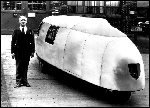 Apart from alternative energy
sources like fuel cells and ethanols, though, we can certainly do better
than we have in terms of efficiency. In 1933, Buckminster Fuller invented
the Dymaxion Car, which
was "intended to fly, jump-jet style, when suitable alloys and engines became
available. Meantime, it did pretty well on the ground: It got about 30 miles
per gallon, and could smoothly hurtle eleven passengers at 120 miles per
hour--far better performance than a 1996 minivan. 20 feet long, it could
U-turn within its own length. The design obsoletes most current eco-car
proposals; only Amory Lovins' "Hypercar" comes close. He and Bucky independently
concluded that a safe, efficient, high-performance car could be economically
built to weigh about a half-ton."
Apart from alternative energy
sources like fuel cells and ethanols, though, we can certainly do better
than we have in terms of efficiency. In 1933, Buckminster Fuller invented
the Dymaxion Car, which
was "intended to fly, jump-jet style, when suitable alloys and engines became
available. Meantime, it did pretty well on the ground: It got about 30 miles
per gallon, and could smoothly hurtle eleven passengers at 120 miles per
hour--far better performance than a 1996 minivan. 20 feet long, it could
U-turn within its own length. The design obsoletes most current eco-car
proposals; only Amory Lovins' "Hypercar" comes close. He and Bucky independently
concluded that a safe, efficient, high-performance car could be economically
built to weigh about a half-ton."
If a car that efficient was built with 1933 technology, wouldn't you think we could have done better than that by now? Perhaps you begin to suspect a failure of will.
The Zero Growth Challenge
The power of our perpetual economic growth myth is pervasive indeed, but we must have the courage to envision a cyclical future for ourselves, and to make it real. We may well wonder if "sustainable development" isn't an oxymoron.
It would be impossible, of course, to simply step on the brakes of our current economy. Markets would tumble, and economic depression (or worse) would ensue. What we need to do is make the transition over a suitable period of time from a growing economy to what Hawken calls a "developing" economy: "A growing economy is getting bigger; a developing economy is getting better."
For example, instead of a pharmaceutical industry that relies on people getting sick in order to grow (and meet their shareholders' expectations), we need a medical industry focused on preventive medicine.
Hawken asserts: "Industrialism is over, in fact; the question remains how we will organize the economy that follows. Either it falls in on us, and crushes civilization, or we reconstruct it and unleash the imagination of a more sustainable future into our daily acts of commerce...At some time in the relatively near future, we will achieve a "balance" between what we are consuming and the capacity of the earth's ecosystems to provide those needs, although under existing models of production and consumption, it is likely to be far different and cause far more suffering than we are presently willing to admit."
Filling Up The Well
While we can strive today to reach zero on the environmental balance sheet, the dirty secret in environmentalism is that sustainability is not enough. We simply do not know enough about the details of how actual living ecosystems sustain themselves, and all of the dependencies between the parts. And it is clear that our burgeoning population will be hard pressed to meet its needs in 50 years with the planetary resources of today. We must actively restore damaged habitats and deteriorating ecosystems so that nature can continue its own sustainable cycles.
We need a business environment in which enterprises can thrive by going beyond regulatory standards instead of fighting them, in which efforts to do the right thing impact the bottom line positively, in which acts of environmental destruction are prohibitively expensive, and in which restorative acts bring prosperity.
The Heart of the Matter
What all of this really comes down to is the same thing that got us here in the first place, those great intangibles known as vision and will. It was the vision of Manifest Destiny and of man's "dominion" over the earth that led us down this straight-line consumptive path. Our will has made over the face of the planet.
And if we are to find our ecological salvation, it is a new vision and a renewed will that will obtain it. We must envision a cyclical, restorative economy; one where products are designed with a plan for their reabsorption into the cycle; one in which manufacturers think of their products cradle to cradle, not cradle to grave.
The will to make this scenario real must be rooted in a deep and intuitive sense of responsibility. We need to reconceive our notions of freedom and responsibility--especially those within the liability-protected confines of a corporation. As Hawken puts it, "Responsibility belongs to the linear, non-cyclical system of today, responsibility is blurred or in some cases nonexistent. By placing both the responsibility and the cost of mitigation with the originator of the problem, vast and compelling incentives are created for companies to redesign, even reimagine, their business and process."
The Real Relation, the Underlying Dream
Considering all of the above, it should encourage a sense of humility. We don't know what the effects are of much that we do. We know that a lot of it isn't sustainable. We know that a willing submission to the cyclical patterns of our environment is critical to our success.
American Indian tribes would not make the kind of large-scale decisions that we make in the markets every day, without first considering the effect that the decision would have on ten generations of descendants. If you can imagine ten generations following you into this world, what do you want to leave them?
When we find business viewing its activities in a purely materialistic fashion, and exploiting the environment, bear in mind that we are part of that environment. The successful business of the future will reverse that relationship, moving away from what Jewish theologian Martin Buber calls the "I-It" relationship to an "I-Thou" relationship based on mutual respect. Businesses who value their relationships with their customers will be able to hang onto them, and those who don't, won't. The smart company will hear negative feedback from its environment (including its customers) and respond to it symbiotically.
None of this requires a huge leap of imagination. It's as simple as remembering the underlying dream, the dream of one's descendants, the dream of a beautiful world in which we perceive ourselves as the simple and respectful brethren of every other inhabitant.
A Question of Values
Farmer poet Wendell Berry lends the ethic some soul: "The world that environs us, that is around us, is also within us. We are made of it; we eat, drink and breathe it; it is bone of our bone and flesh of our flesh. It is also a Creation, a holy mystery, made for and to some extent by creatures, some but by no means all of whom are humans. This world, this Creation, belongs in a limited sense to us, for we may rightfully require certain things of it--the things necessary to keep us fully alive as the kind of creature we are; but we also belong to it, and it makes certain rightful claims upon us: that we leave it undiminished, not just to our children, but to all the creatures who will live it in after us."
Jerry Kohlberg, formerly of the Kohlberg Kravis Roberts partnership, put it this way: "Around us there is a breakdown of...values in business and government...It is not just the overweening, overpowering greed that pervades our business life. It is the fact that we are not willing to sacrifice for the ethics and values we profess. For an ethic is not an ethic, and a value not a value, without some sacrifice for it, something given up, something not taken, something not gained. We do it in exchange for a greater good, for something worth more than just money and power and position."
He's right. We do it to ensure our own futures.

| Disclaimer .© Copyright 1995, 1996 Better World Publishing .... All rights reserved. Better WorldSM and BWZ are Service Marks of Better World Publishing Questions and comments? |

|
|
