

 |
Electric and Recyclable Cars |

The year was 1897. Horse-drawn carriages and trains were the transportation options of the day. The United States would soon be embroiled in the Spanish-American war.One year after completing his first car, Henry Ford was introduced to Thomas Edison at a conference in New York. There he first learned of Edison's interest in producing an electric car. But Ford quickly overwhelmed Edison with his description of a gas-powered vehicle.
The two great inventors became friends and eventually neighbors at their winter residence in Fort Myers, Florida. But Edison's dream of an electric automobile would never make its mark in the 20th century as did the gas-powered car, or the two companies they originally founded--General Electric and the Ford Motor Company.
Today, nearly a century after the idea was first contemplated, commercial automobile manufactures are finally starting to introduce vehicles that address both the needs of the consumer--mobility, convenience, and affordability--and the environment.
Although developing an electric car is not a new concept, legislation requiring new vehicles to have a lesser impact on the environment is now a driving force behind the push for alternatives. The new crop boasts innovations in battery technology, new ideas in practical application, and exciting products being unveiled by automakers this year--which should appear on the showroom floors as early as this winter.
Legislation for Recycling
Around the world, governments are taking a much more pro-active stance--often working closely with industry--to develop programs and implement legislation favorable to a sustainable future.
In 1993, President Bill Clinton and Vice President Al Gore announced a joint venture with American automakers aimed at increasing fuel efficiency by three-fold in less than 10 years' time. The partnership also envisioned a technology that could produce vehicles that were competitively priced and offered high performance while producing lower levels of pollutants and being safe to operate.
The German government also adopted legislative measures which require manufacturers and retailers to collect and recycle packaging for a wide range of products. Since 1995, German firms have had to recycle 80 percent of the products. As a result, many product manufacturers are redesigning their products to be disassembled and recycled.
Probably the most well-known example of this type of effort is in the automobile industry. In 1988, BMW introduced a limited production edition of a two-seat roadster which can be quickly disassembled. The car's plastic body panels are coded for easy recycling.
In the U.S., 94% of all automobiles are collected for recycling, and 75% of the vehicle weight is recycled. As a result of the Clean Air Initiatives of California, New York, and Massachusetts, which mandates that 2% of new car sales be electric vehicles starting in 1998, some domestic car manufacturers, such as Ford and GM, as well as other foreign auto manufacturers like Toyota and Volkswagen will introduce recyclable cars in the near future.
Alternative Technologies
To the public, the importance of fuel-economy technology rises and falls with gasoline prices. It is believed that rising gas prices will spur the demand for new mid-size autos that are more fuel efficient--reaching about 30 mpg by 2005 and 33 mpg in 2015. Experts agree that cars will attain these results--while becoming safer, roomier, more powerful, and less taxing on the environment. (See the Cover Story for more on this subject.)
Both existing and emerging technologies offer the advancements needed to substantially improve fuel economy. By 2005, automakers hope to introduce mass-market vehicles to the consumer that can achieve 50 to 100 percent better fuel economy than today's vehicles.
The requirements for successful commercialization of vehicles that use alternative technologies are:
- Manufacturing Cost
- Retail Price
- Operating and Maintenance Costs
- Performance
- Range
Although significant strides have been made in creating a more efficient vehicle, there are three technologies contending to be the power source for the next generation vehicle.
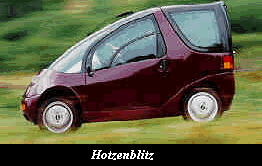 Electric Vehicles
The electric vehicle (EV) is currently the only type capable of satisfying the California zero-emission mandates. The future performance and costs of EVs are controversial--economies of scale have not yet been achieved.
Some promising numbers have been posted giving cause for optimism for the EV market. Achieving speeds approaching 70 mph (110-120km/h) and ranges upwards of 85 miles (130-135km) can be attributed to significant advances in battery technology and more efficient vehicle designs. However, the major auto manufacturers claim that any EVs produced now and in the next few years will have limited range and much higher initial and operating costs than comparable gasoline vehicles.
Hybrid-Electric Vehicles (HEVs)
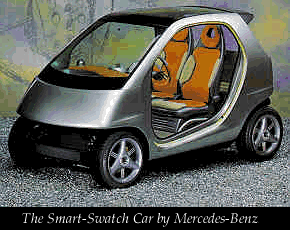 Hybrids are vehicles that combine an internal
combustion engine and a battery in a single vehicle, using electric motors
to provide some or most of the vehicle's propulsion. The hybrid drive-train
offers several advantages: the limited range becomes either less of a problem
or no problem, a portion of inertia losses can be recovered through regenerative
braking, and the engine can be operated at near-maximum efficiency. A key
disadvantage can be the added weight, cost, and complexity of the hybrid's
multiple components.
Hybrids are vehicles that combine an internal
combustion engine and a battery in a single vehicle, using electric motors
to provide some or most of the vehicle's propulsion. The hybrid drive-train
offers several advantages: the limited range becomes either less of a problem
or no problem, a portion of inertia losses can be recovered through regenerative
braking, and the engine can be operated at near-maximum efficiency. A key
disadvantage can be the added weight, cost, and complexity of the hybrid's
multiple components.
Currently, HEVs offer no distinct advantage in fuel economy over conventional technology in the marketplace, but there is an intriguing feature of many of these hybrids. By using batteries for energy storage, HEVs can operate in battery-only mode for some distance. This would allow HEVs to enter and operate in areas restricted to EV operation (such as inner cities) or in an "emergency"--whether the car is simply out of gas or another oil supply crisis arises.
Fuel Cell Vehicles
Fuel cells are electrochemical devices that turn hydrogen directly into electricity without combustion, at high efficiency and with emissions of water only. For a fuel cell-powered vehicle, the hydrogen can either be carried onboard or produced from a hydrogen-rich fuel such as methanol.
The problem with fuel cells is cost and size. Fuel cells cost thousands of dollars per kW and are too large to fit comfortably in a light-duty vehicle. Researchers hope to reduce their costs to less than $40/kW and shrink their size to fit into a car without reducing its cargo space.
What's Real
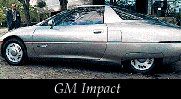
The GM Impact electric, now called the EV-1, is due in Saturn show rooms in California and Arizona this winter. The cars will be offered in four test markets: Phoenix, Tucson, Los Angeles and San Diego.
 These places were chosen primarily because of their mild weather conditions
and flat terrain. In preparation for the new EVs, Arizona Public Service
Co. recently announced 10 sites for charging stations, all anchored to APS
facilities. Two of them, one at the Arizona Center in downtown Phoenix and
one near Scottsdale Civic Plaza, are in place now. The Salt River Project
announced that four recharging stations would be completed at various outside
malls in the Phoenix area by Christmas. The stations are designed to recharge
the EV-1 electric sports car that's being marketed in the Valley, as well
as other electric vehicles expected to arrive here in coming years.
These places were chosen primarily because of their mild weather conditions
and flat terrain. In preparation for the new EVs, Arizona Public Service
Co. recently announced 10 sites for charging stations, all anchored to APS
facilities. Two of them, one at the Arizona Center in downtown Phoenix and
one near Scottsdale Civic Plaza, are in place now. The Salt River Project
announced that four recharging stations would be completed at various outside
malls in the Phoenix area by Christmas. The stations are designed to recharge
the EV-1 electric sports car that's being marketed in the Valley, as well
as other electric vehicles expected to arrive here in coming years.
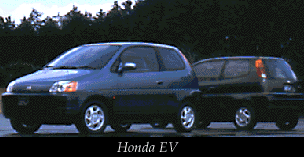 Earlier this year Honda Motor Co. introduced the
Honda EV which has a body specifically designed for an electric vehicle and
which is powered by nickel-metal hydride batteries. The model will be available
for lease in California beginning in the spring of 1997.
Earlier this year Honda Motor Co. introduced the
Honda EV which has a body specifically designed for an electric vehicle and
which is powered by nickel-metal hydride batteries. The model will be available
for lease in California beginning in the spring of 1997.
In Norway, PIVCO AS has developed an electric vehicle, called the CityBee. The CityBee has become a major focus of a BART demonstration in the Bay area. BART has contracted with Green Motorworks, Inc. of Southern California to lease 40 two-passenger vehicles. Carpool teams, individuals, or their employers will pay Green Motorworks $100 to $150 per month to use each vehicle.
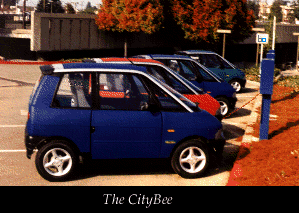
The demonstration is expected to be fully operational this month. The first customer, Sybase, Inc. of Emeryville, California, has leased nine vehicles to be used by their employees. These and other demonstrations are being closely monitored by the National Station Car Association.
Future Challenges
According to the Office of Technology Assessment (OTA), for the next few years advanced vehicles are likely to cost substantially more than their conventional counterparts, and the savings resulting from their lower fuel consumption will not offset their higher purchase prices.
Although some analysts have claimed that operating and maintenance costs for advanced vehicles will be much lower than for conventional vehicles, evidence for such claims is weak. These conclusions obviously raise valid concerns about the marketablilty of advanced vehicles, especially given current consumer disinterest in fuel economy.
Successful commercialization of the electric vehicle hinges on several important economic factors:
- The widespread adoption of environmental design initiatives in the private sector
- Greater consumer enthusiasm for the development of alternative vehicles
- Challenging auto makers, through legislation or consumer demand, to produce more cost-effective and higher performance alternative vehicles
- Continuing to encourage and reward research programs to improve existing technology.
Although alternative vehicle manufacturers are springing up to cash in on new environmental legislation, the real story will be told on the showrooms of the major auto dealers. Will consumers accept alternative vehicles this time around?
Stay tuned to Better World 'Zine...we'll be the first to let you know!

| Disclaimer . © Copyright 1995, 1996, Better World Publishing All rights reserved. Better WorldSM and BWZ are Service Marks of Better World Publishing .... Questions and comments? |  |
|
