
A NATIONAL TREASURE THREATENED
|
| UTAH'S REDROCK WILDERNESS:
A NATIONAL TREASURE THREATENED |
"IF YOU KNEW WILDERNESS IN THE WAY THAT YOU KNOW LOVE, YOU WOULD BE UNWILLING TO LET IT GO. WE ARE TALKING ABOUT THE BODY OF THE BELOVED, NOT REAL ESTATE. WE MUST ASK OURSELVES AS AMERICANS, 'CAN WE REALLY SURVIVE THE WORSHIP OF OUR OWN DESTRUCTIVENESS?'"
- Terry Tempest Williams, Utah citizen
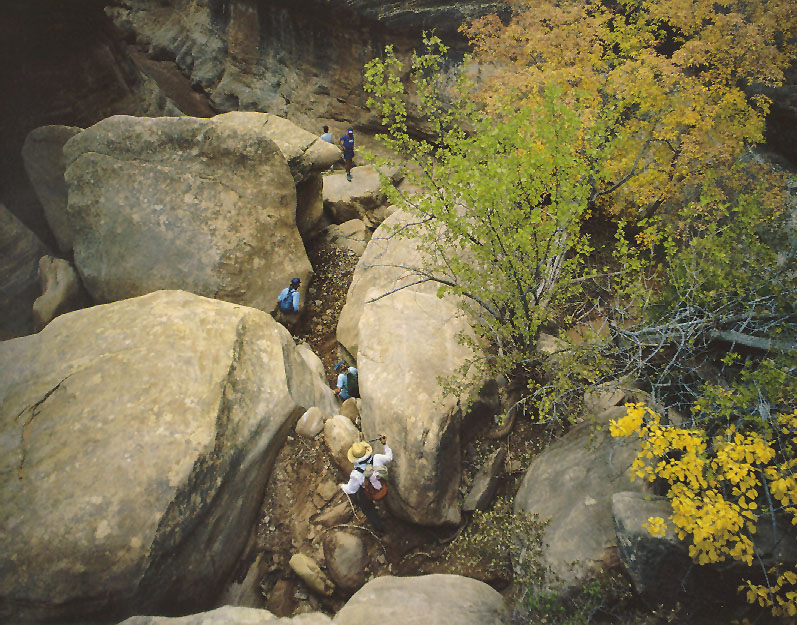
Gravel & Long Canyons, Hikers climbing down among house-sized boulders. © RAY WHELER | GLEN AND WHITE CANYONS. The sheer-walled slot canyons and forested benches of this region are important habitat for native desert bighorn sheep and other sensitive wildlife populations. H.R.1745/S.884 is a mandate for development of two large blocks of roadless BLM land bordering Glen Canyon National Recreation Area (GCNRA) and Natural Bridges National Monument. Near GCNRA, mineral development could occur on over 60,000 acres surrounding Moqui Canyon, an 800 foot-deep canyon system featuring a perennial stream, soaring cliff walls, and dozens of important archeological sites. Of 85,000 acres of roadless BLM lands which surround Natural Bridges National Monument and link it to GCNRA, H.R.1745/S.884 would protect not one acre as designated wilderness, leaving more than 100 miles of spectacular canyons and mesas wide open for uranium and petroleum exploration and the continuing proliferation of stock ponds and roads. |

 Next
Next
Slide Show Menu | BWZ Table of Contents | The Battle for the Utah Wilderness | What You Can Do
Content © 1995 Southern Utah Wilderness Alliance (SUWA)

| 
| Disclaimer . ©Copyright 1995, 1996, Better World Publishing All rights reserved. Better WorldSM and BWZ are Service Marks of Better World Publishing Questions and comments? | 
|