
|
Better World Book Review |

|
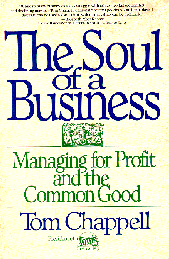
The Soul of a Business
|


 It's not your average CEO who would take a leave of absence from
his or her successful corporation to attend Harvard Divinity School to study
how one's personal values could be used at a professional level to create
both profit and spiritual fulfillment. But Tom Chappell, President and co-founder
of Tom's of Maine--a corporation that makes and markets all-natural personal
care products--did just that, to learn how a company could behave in a "socially
responsible and enviromentally sensitive" manner while remaining financially
competitive and profitable.
It's not your average CEO who would take a leave of absence from
his or her successful corporation to attend Harvard Divinity School to study
how one's personal values could be used at a professional level to create
both profit and spiritual fulfillment. But Tom Chappell, President and co-founder
of Tom's of Maine--a corporation that makes and markets all-natural personal
care products--did just that, to learn how a company could behave in a "socially
responsible and enviromentally sensitive" manner while remaining financially
competitive and profitable.
The Soul of a Business is the geniune article, a bible (so to speak) of a new genre of books about corporations going green. It's no secret that most companies have an environmental slant simply as a new angle from which to market their product (e.g., the refillable laundry bottle that can eventually be crushed down into wheat thins and used as dog biscuits). For many, going green is simply another way to call attention to themselves by selling the same stuff in new packaging. Some of the new marketing may be good, some may be a con. But in Chappell's book, he obviously thinks and writes on a deep and sincere level about "doing well by doing good". It is a book by a man who has come to a familiar crossroads: one wherein success and all one has strived for becomes a really--but discontentment still settles in. There is something beneath money, power, prestige (at least we'd all like to think so; hence it's refreshing to hear such spiritual longing from a guy who actually has money, power, and prestige).
There is no more succinct way of describing the tone of The Soul of a Business then James A. Autry's blurb on the back cover: "This is not a touchy-feely, new age guide to running a business....Chappell has given us as disciplined and hard-nosed an approach as any you will find. The difference is that rather than putting his faith and expectations in systems and procedures, he has demonstrated how putting his faith and expectation in people will pay off in productivity, market share, and profits."
Though Chappell admits to having a spiritual side, he makes it clear from the outset that "This is not a book about religion and work. It is not about God as CEO, and it is not about New Age spirituality in the workplace. It's about how to use the two sides of all of us, the spiritual and the practical, to achieve whatever business goals you set for yourself." Hence, while it may be amusing (on one level) to read chapter headings like "The Board of Directors Meets Martin Buber" (wherein all the members of the board and his managers received copies of I and Thou) it also makes good sense. The great thinkers of all ages should be applied to the workplace, and human beings do have inherent quality and should be treated with respect. Stating your phillosophy is one thing; doing it is quite another; teaching it to others is an even more spectacular feat.
The Soul of a Business is a book that shouldn't be analyzed too deeply from the outside. Rather, one should read the book itself and see how Chappell's wonderful logic unfolds. Finding himself at a spiritual crossroads, lacking fulfillment despite success, he sets off in pursuit of the twin goals of making money and doing well for the community. From there, he spends four years traveling to Harvard Divinity school, studying the great religious thinkers of all time, and bringing those ideas back to his company to be applied in the business world. Emergently, he and his company arrive at ways of "managing for profit and the common good."
In Chappell's book, one finds a man asking some soul-searching questions and can't help but ask themselves soul-searching questions in return. What is your identity? How do you identify your values? How do you apply those values once you determine them? How does one "break away" from the mass of society that may not have the faith or strength to pursue new ideas?
It's not that Chappell doesn't ask tough questions--he does--it's just that the questions he asks make sense. Returning to Buber's I and Thou, Chappell can adapt this philosophy directly into his own business. For example, rather than the typical "I-It" approach (or "us and them") which he sees as the mentality of the majority of American business, he tries to bring Buber's I-thou relationship to others on a daily level. Why shouldn't customers be part of one's business? Why shouldn't manufacturers be on a one-to-one level with their customers? Why shouldn't consumers be more than a statistic and the materials that go into a product be wholesome and healthy for both customer and the earth? More than idealism, it stands to reason that this philosophy (what Chappell dubs, after Jonathan Edwards, the "Being is Relation" attitude) would draw consumers back to a company that truly cares about its community, its consumers, and the earth from which the product is produced? "Being is relation" is a process which applies to everyone, everywhere. It is in our relation to our souls, relation to our morals, relation to each other, relation to customers, relation to the natural world.
The fascinating thing about The Soul of A Business is the clarity of Tom Chappell's expression of rather complex ideas. In the book, he prints a clear-cut Mission Statement and Statement of Beliefs developed collaboratively within the company, and proceeds to show how they implemented the mission, helped build a community based on mutual respect, defined "goodness" and gave to charity. Whether it is honoring diversity, learning trust, or empowering others, Tom's of Maine is an excellent example of what a utopian business can be--simply a business that cares and gives to, instead of just taking from, their community. The Soul of a Business is nothing less than a blueprint for building a better world.
As Chappell himself writes, "I know that we--the business community--can change our traditional business culture. The mind will calculate forever, but the heart will eventually give in. We need to help each other. Whatever our diffferences, our strength is in affirming our identity and joining together to solve our common problems and aspiring to our common aims--to rebuild our community life, to clean up our local waters and air, to reach out to our needy neighbors, to re-seed the village green.
"For those of you who feel the same tug, I have a place in Kennebunk, Maine, called Partners for the Common Good. We are private and commercial businesses as well as nonprofit groups working on common causes. We share the same values, work together in different circles, and solve the particular problems of the village green. Informally connected, we ask questions and share stories about how to integrate the common good into our particular buisinesses. Then we inspire each other to action."
You, the reader, may be in a position to join such an alliance for the common good. Or you could be an employee just happy to know that some people in top management levels actually think and act on their heartfelt philosophies. But as we look at our world, and all of its needs, we can't help but feel reassured that people are striving to manage for profit and the common good.
It is these specific steps that will help build a better world for all of us.


| Disclaimer . © Copyright 1995, Better World Publishing All rights reserved. Better WorldSM and BWZ are Service Marks of Better World Publishing .... Questions and comments?" |
|
|
